Envoy Gateway
With Envoy Gateway, tenants can publish their applications through the Gateway API while the platform manages the Gateway infrastructure. This guide covers protecting platform Gateways, generating a managed Gateway per Tenant, and delegating listeners with Capsule hostname rules. Before starting, review the upstream documentation:
- Gateway API roles and personas
- Envoy Gateway deployment modes and multi-tenancy
- Gateway API ListenerSets
The examples assume Envoy Gateway is installed and a tenants GatewayClass is
available. Examples using allowedListeners also require Gateway API CRDs and
an Envoy Gateway release supporting gateway.networking.k8s.io/v1 ListenerSets.
Secure Gateways
For Gateways that are reserved for platform services, exclude Tenant namespaces
from allowedRoutes. Capsule labels Tenant namespaces with
capsule.clastix.io/tenant, so a DoesNotExist selector allows routes only from
namespaces outside Capsule Tenants. Disable delegated listeners with
allowedListeners.namespaces.from: None:
apiVersion: gateway.networking.k8s.io/v1
kind: Gateway
metadata:
  name: platform-gateway
  namespace: platform-system
spec:
  gatewayClassName: tenants
  allowedListeners:
    namespaces:
      from: None
  listeners:
    - name: http
      port: 80
      protocol: HTTP
      allowedRoutes:
        namespaces:
          from: Selector
          selector:
            matchExpressions:
              - key: capsule.clastix.io/tenant
                operator: DoesNotExist
Keep these Gateways and their infrastructure in platform-owned namespaces that Tenant owners cannot modify. For Gateways intended for a Tenant, select that Tenant’s namespace label instead, as shown below. Capsule ingress rules then restrict the hostnames used by resources inside those namespaces.
Managed Gateways
One approach is to generate a dedicated Gateway for each Tenant. The platform
creates a tenant-<tenant-name>-system namespace outside the Tenant, where it
manages the Gateway, EnvoyProxy, and TLS certificates. Tenant owners manage
HTTPRoutes in their own namespaces:
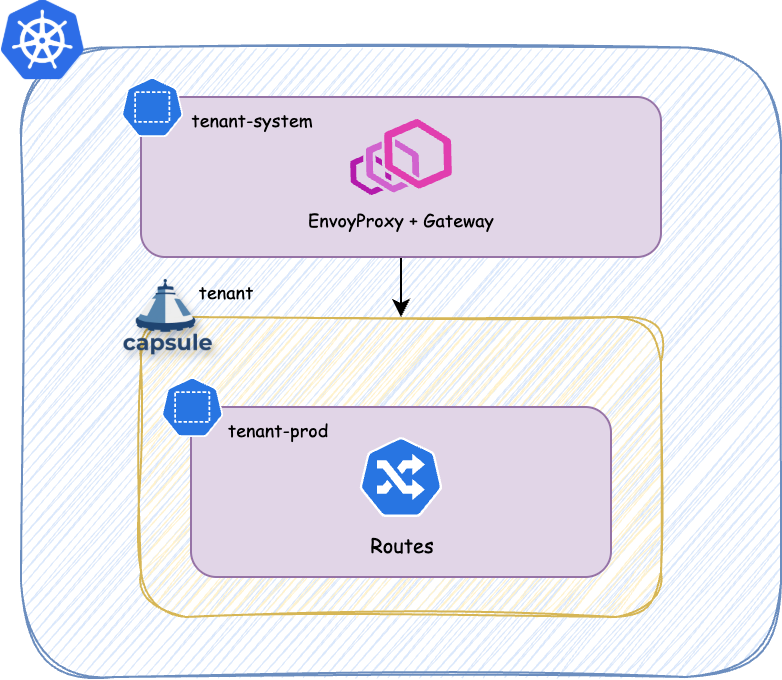
Gateway generation
The following GlobalTenantResource generates the
managed Gateway and EnvoyProxy. The EnvoyProxy configures the Envoy instances;
the Gateway defines listeners and their allowed routes. Create the platform
namespaces and the tenant-critical PriorityClass before using this example.
The resource collects HTTPRoutes labeled
projectcapsule.dev/tenant: <tenant-name> and generates an HTTPS listener for
each hostname. Tenant data can supply
bandwidth limits and a load balancer address. The Gateway annotations reference
the namespaced Issuer configured under Certificate management.
---
apiVersion: capsule.clastix.io/v1beta2
kind: GlobalTenantResource
metadata:
  name: managed-envoy-gateway
spec:
  scope: Tenant
  resyncPeriod: 30s
  resources:
    - context:
        resources:
          - apiVersion: gateway.networking.k8s.io/v1
            kind: HTTPRoute
            index: https
            selector:
              matchLabels:
                projectcapsule.dev/tenant: "{{tenant.name}}"
      generators:
        - missingKey: zero
          template: |
            {{- $ingressBandwidth := dig "spec" "data" "networking" "ingress" "bandwidth" "" $.tenant }}
            {{- $egressBandwidth := dig "spec" "data" "networking" "egress" "bandwidth" "" $.tenant }}
            {{- $loadBalancerIP := dig "spec" "data" "networking" "ingress" "loadbalancer" "" $.tenant }}
            ---
            apiVersion: gateway.envoyproxy.io/v1alpha1
            kind: EnvoyProxy
            metadata:
              name: tenant-{{ $.tenant.metadata.name }}-gateway
              namespace: tenant-{{ $.tenant.metadata.name }}-system
            spec:
              logging:
                level:
                  default: info
              provider:
                type: Kubernetes
                kubernetes:
                  envoyDeployment:
                    replicas: 2
                    pod:
                      priorityClassName: tenant-critical
                      {{- if or $ingressBandwidth $egressBandwidth }}
                      annotations:
                        {{- with $ingressBandwidth }}
                        kubernetes.io/ingress-bandwidth: {{ . }}
                        {{- end }}
                        {{- with $egressBandwidth }}
                        kubernetes.io/egress-bandwidth: {{ . }}
                        {{- end }}
                      {{- end }}
                  {{- with $loadBalancerIP }}
                  envoyService:
                    loadBalancerIP: {{ . }}
                  {{- end }}

        - missingKey: zero
          template: |
            ---
            apiVersion: gateway.networking.k8s.io/v1
            kind: Gateway
            metadata:
              name: tenant-{{ $.tenant.metadata.name }}-gateway
              namespace: tenant-{{ $.tenant.metadata.name }}-system
              annotations:
                cert-manager.io/issuer: tenant-{{ $.tenant.metadata.name }}-acme-http
                cert-manager.io/private-key-size: "4096"
                cert-manager.io/private-key-algorithm: RSA
            spec:
              gatewayClassName: tenants
              infrastructure:
                parametersRef:
                  group: gateway.envoyproxy.io
                  kind: EnvoyProxy
                  name: tenant-{{ $.tenant.metadata.name }}-gateway
              listeners:
                - name: http-challenge
                  port: 80
                  protocol: HTTP
                  allowedRoutes:
                    namespaces:
                      from: Same
                {{- range $_, $http := $.https }}
                  {{- range $i, $hostname := $http.spec.hostnames }}
                - name: {{ $http.metadata.namespace }}-{{ $http.metadata.name }}-{{ $i }}
                  port: 443
                  protocol: HTTPS
                  hostname: {{ $hostname }}
                  tls:
                    mode: Terminate
                    certificateRefs:
                      - group: ''
                        kind: Secret
                        name: {{ $http.metadata.namespace }}-{{ $http.metadata.name }}-{{ $i }}-tls
                  allowedRoutes:
                    namespaces:
                      from: Selector
                      selector:
                        matchLabels:
                          kubernetes.io/metadata.name: "{{ $http.metadata.namespace }}"
                  {{- end }}
                {{- end }}
Certificate management
To manage certificates with cert-manager, enable
its Gateway API support and generate an Issuer in each platform namespace.
This Issuer uses ACME HTTP-01 challenges
through the managed Gateway’s http-challenge listener, which accepts solver
routes from the same platform namespace. The
Gateway annotations above let
cert-manager create the certificates for its generated HTTPS listeners:
apiVersion: capsule.clastix.io/v1beta2
kind: GlobalTenantResource
metadata:
  name: tenant-acme-issuer
spec:
  scope: Tenant
  resources:
    - rawItems:
        - apiVersion: cert-manager.io/v1
          kind: Issuer
          metadata:
            name: "tenant-{{tenant.name}}-acme-http"
            namespace: "tenant-{{tenant.name}}-system"
          spec:
            acme:
              email: platform@email.com
              server: https://acme-staging-v02.api.letsencrypt.org/directory
              privateKeySecretRef:
                name: cert-letsencrypt-staging
              solvers:
                - http01:
                    gatewayHTTPRoute:
                      parentRefs:
                        - group: gateway.networking.k8s.io
                          kind: Gateway
                          name: "tenant-{{tenant.name}}-gateway"
                          namespace: "tenant-{{tenant.name}}-system"
                          sectionName: http-challenge
Tenant ListenerSets
Another approach is to let tenants define listeners and certificates while the
platform manages the Gateway and its Envoy infrastructure. The Gateway allows
ListenerSets from the Tenant’s namespaces;
a Capsule ingress rule restricts their hostnames to subdomains of
solar.example.com.
Reuse the managed EnvoyProxy and tenants GatewayClass from
Managed Gateways, and replace the generated Gateway
configuration with the one below. If using a GlobalTenantResource, update its
Gateway generator and remove the HTTPRoute context lookup and the loop that
generates HTTPS listeners. Tenants now provide those listeners themselves.
Tenant hostname rule
The platform administrator configures the solar Tenant with an allow rule for
both ListenerSets and HTTPRoutes:
apiVersion: capsule.clastix.io/v1beta2
kind: Tenant
metadata:
  name: solar
spec:
  owners:
    - kind: User
      name: alice
  rules:
    - enforce:
        action: allow
        ingress:
          types:
            - ListenerSet
            - HTTPRoute
          hostnames:
            - exp: '^.+\.solar\.example\.com$'
The rule applies to every namespace belonging to solar. Capsule checks each
listener’s hostname and every entry in an HTTPRoute’s spec.hostnames during
creation and updates. The anchored expression allows hostnames at any depth
below solar.example.com, including wildcard hostnames within that domain.
It excludes the parent hostname solar.example.com itself. Targeting both
resource types ensures that the same policy also applies to routes attached
directly to the Gateway.
| Hostname | Rule result |
|---|---|
web.solar.example.com | Allowed |
api.prod.solar.example.com | Allowed |
*.solar.example.com | Allowed |
solar.example.com | Denied |
web.lunar.example.com | Denied |
web.solar.example.com.evil.com | Denied |
Allow tenant ListenerSets on the managed Gateway
The platform owns this Gateway in tenant-solar-system, outside the Tenant.
allowedListeners selects namespaces by Capsule’s tenant label, allowing
ListenerSets from solar namespaces to attach without listing their hostnames
on the Gateway:
apiVersion: gateway.networking.k8s.io/v1
kind: Gateway
metadata:
  name: tenant-solar-gateway
  namespace: tenant-solar-system
spec:
  gatewayClassName: tenants
  infrastructure:
    parametersRef:
      group: gateway.envoyproxy.io
      kind: EnvoyProxy
      name: tenant-solar-gateway
  allowedListeners:
    namespaces:
      from: Selector
      selector:
        matchLabels:
          capsule.clastix.io/tenant: solar
  listeners:
    - name: http-challenge
      port: 80
      protocol: HTTP
      allowedRoutes:
        kinds:
          - group: gateway.networking.k8s.io
            kind: HTTPRoute
        namespaces:
          from: Selector
          selector:
            matchLabels:
              capsule.clastix.io/tenant: solar
allowedListeners controls which namespaces can attach ListenerSets;
allowedRoutes controls which routes can attach to an individual listener.
The Capsule rule supplies the hostname restriction in the tenant namespaces.
The platform-owned Gateway is outside that rule’s scope, so its HTTP challenge
listener can omit hostname.
Tenant listener and route
Assume solar-production belongs to solar, contains a solar-web Service on
port 8080, and has a TLS Secret named solar-web-tls with a certificate for
web.solar.example.com. Alice creates an HTTPS listener in that namespace:
apiVersion: gateway.networking.k8s.io/v1
kind: ListenerSet
metadata:
  name: solar-web
  namespace: solar-production
spec:
  parentRef:
    group: gateway.networking.k8s.io
    kind: Gateway
    name: tenant-solar-gateway
    namespace: tenant-solar-system
  listeners:
    - name: https
      hostname: web.solar.example.com
      port: 443
      protocol: HTTPS
      tls:
        mode: Terminate
        certificateRefs:
          - group: ""
            kind: Secret
            name: solar-web-tls
      allowedRoutes:
        kinds:
          - group: gateway.networking.k8s.io
            kind: HTTPRoute
        namespaces:
          from: Same
The Secret is in the ListenerSet’s namespace. The HTTPRoute attaches to that
ListenerSet, selecting its https listener:
apiVersion: gateway.networking.k8s.io/v1
kind: HTTPRoute
metadata:
  name: solar-web
  namespace: solar-production
spec:
  parentRefs:
    - group: gateway.networking.k8s.io
      kind: ListenerSet
      name: solar-web
      sectionName: https
  hostnames:
    - web.solar.example.com
  rules:
    - backendRefs:
        - name: solar-web
          port: 8080
Capsule admits both resources because all their hostnames match the Tenant rule.
Changing the ListenerSet hostname or any HTTPRoute hostname to web.lunar.example.com
is denied at admission, even though the Gateway allows ListenerSets from that
namespace. Adding a disallowed hostname alongside web.solar.example.com also
denies the entire request. Omitting a listener hostname or the route’s
spec.hostnames is denied because an allow rule targets these resource types.